Tuesday, 29 June 2010

Week 23: Wolfgang Tillmans/Serpentine Gallery

Hello pursuers everywhere, despite major dental surgery this week am still on the ball in blogland woohoo me. This week I used up my get out of jail free cultural pursuit card; the Serpentine Gallery. I live 5 minutes walk from Hyde Park (smug smug smug) so it was always my back up for v lazy (and hot, prey to god there are more like that) weekends when couldn’t be bothered to travel anywhere. Am already planning on 'going to the pavilion' and also maybe 'going to see something at the pavilion' - ooh a fantastic summer of blogs awaits...? Anyway, I dragged my codined-up self from the shady fab spot had been languishing in for 5 hours and managed a whole 25 minutes of standing up and looking at art before collapsing back in the exact same spot for another hour or so. God I love summer.
The show: Wolfgang Tillmans. So, a few weeks ago I wrote an even more crap than usual blog about a really rather good photography exhibition I had seen at the Tate Modern. Somewhat, I suspect, to many peoples dismay and consternation I vocalised my belief, which still stands, that almost any photograph can look 'good' if blown up, framed well, and put on the wall of a gallery. Obviously anyone who knows about photography (unlike me clearly) will disagree with this, which is fine, but they must surely agree that Wolfgang Tillmans has made a career out of doing just that, in the best best possible way. I mean his entire canon seems to be about making things look good by hanging them in certain, differing ways, or at least that’s what they seemed to think in the little booklet that came with the exhibition. His work is all about placing random, lets face it in many cases pretty damn standard pictures on walls in different interesting ways and seeing what happens. Pieces from different times in his career (apparently - I didn’t read the labels) are juxtaposed, creating interesting cross references and associations, changing the meaning of pieces from the way they would have been viewed in different settings. I like this idea a lot, and I liked SOME of the images, but a hell of a lot of them were a load of crap, I mean I get the latent romanticism of the domestic and all that but a lot of these were either boring, badly realised, or, well, boring. That’s fine though I enjoyed it mostly for the over arcing concept anyway.

I like the site-specific nature of his work and also the way he articulates my personally experience of moving through a gallery space. This is particularly strong when in galleries which I know well, with pieces I have studied or really love; they are all like old friends who you are meeting briefly in a crowd, or like having a conversation you have had over and over again but changes constantly and never gets boring. Each piece speaks to the others, saying different things depending on what you look at, in what order, at what time, depending on where they are placed in relation to each other – etc, I love that!!
Anyway, enough of all that gush. One thing I will say for the guy is that he really bought the best out of the space. I can’t remember the last time the Serpentine looked so fab. The last few shows I remember seeing there (obviously not going that often) have really closed up the space, all dark rooms for video projections or stuffy small spaces filled with felt (although that may have been a dream). Anyway, the place looked bloody awesome and about 3 times the usual size - it was all light and airy and lovely and the whole experience was totally summery and delightful.
There was quite a lot of stuff which no doubt 'challenged our perception of photography as a medium, or object’, or whatever. To be honest I thought this stuff was all as dull as dull could be but could see the appeal if you like that sort of thing or were employed to write essays on such things but was not much fun for me as an experience. I guess he was playing with the idea of the photograph as an object as well as a canvas-like space – creating photographic 3-D sculptures by bending and folding photos so they exist in different planes of space, both physically and theoretically – or whatever. Once again he is using the display as part of the work – placing the images in glass cases which somewhat fetishise them. I do like the way he clearly plays around to get different effects though, stretching the traditional processes to create new types of images, obvious may be a word that springs to mind personally but there we go:


He explores this display device further in work that’s use vitrines, or semi-vitrines, out of collections of found objects such as newspaper articles, adverts, napkins in one instant, and other such images and objects. There were 3 of these in one central space and they were each about a different theme. Unfortunately I have forgotten what the first one was about, think the second one was about homosexuality and religion/Catholicism, and couldn’t for the life of me work out what the third was on about; something about consumerism and us ruining the planet by going to Pret? Am not sure, they were fun though – one had some carpet on it, but that’s the one I don’t remember anything about - oops.


One room, which looked out onto the park rather beautifully, had some lovely painterly pieces which were all swirly and pretty-pretty and enjoyable by anyone on earth. I’m not knocking that, but I have to say that there was definitely something a tad saccharine about them:


Anyway, have to say don’t remember much else from the show, was pretty out of it, but enjoyed it for the overarching experience as opposed to most of the photographs – but I really really think that’s the point of it anyway so it’s fine.

On the way to the gallery/my picnic spot I did incidentally find ANOTHER Watts monument – he must have filled London with various weird things which is bloody great news and may lead to a new weekly, or as frequent as possible, section of my blog called Watts Spots. This week it was the monument to Physical Energy (below) which was really rather good I thought. For one thing it was facing the Albert Memorial and yet covering his eyes – as if he was protecting himself from the glare of all that hideous (yet fab) bloody gold. It was also perfect timing as the sun was directly in front and the hand was casting shade exactly over the eyes of the statue so it looked pretty good! According to the internet this is Watts’s moist ambitious sculpture and there are versions in Cape Town and somewhere else which is important for some reason. I don’t know but it feels pretty dynamic and worth a slight detour if you haven’t seen it before. What Watts will it be next week I wonder?

Monday, 21 June 2010

Week 22: Empire Mail / Guildhall Gallery

Merry Monday pursuers everywhere! Tomorrow I am going in to have my evil mutant wisdom tooth of doom surgically removed and am taking the rest of the week off – I therefore have a thousand and one things to do today but am I doing any of them – HELL NO! Hoho. Instead I am championing odd cheap exhibitions everywhere, as usual.

This week I was joined in my cultural pursuit by the lovely Sam, or PhD Sam as he has been known when gracing this blog previously. We had originally intended to go to the Surreal House, or whatever it’s called, at the Barbican. This was Sam’s idea and alas I hadn’t quite made the link in my head that this was about SURREALISM, rather than just being some weird installation piece. Therefore, come Sunday in the City the last thing either of us really wanted to do was be intellectually and artistically challenged and instead were desirous of looking at some pretty pictures, preferably old ones. Thus at the suggestion of clever Sam we headed instead to the lovely, and much underappreciated, Guildhall gallery– GOOD call!

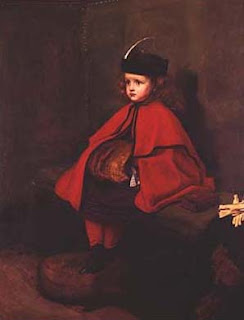
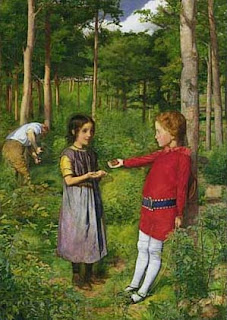
The Guildhall is totally ace. For one thing it is only £2.50 to get in which includes both the exhibition and the rather wonderful permanent collection AS WELL as arguably the best bit = the Roman amphitheatre in the basement!!! You therefore get three things for the price of one woohoo! Would highly recommend a visit to the amphitheatre alone if for nothing other than the funny illuminated green bums they have all over the place to symbolise athletes and gladiators etc. It’s hilarious and truly 80s. The poor bastards didn’t realise it was there until they started building the gallery and had to stop for about 20 years until it was properly excavated– must have been TRES annoying for them! The permanent collection is fab fab fab as they have some really wonderful Victoriana in there including My First Sermon and My Second Sermon by Millais and the CRAZY Woodman’s Daughter by the same artist:
They also have the amazing Israel in Egypt by Poynter which my old tutor Caroline Arscott wrote a very cool essay on all about muscular Christianity if I remember rightly: (check out the hot bods in this):


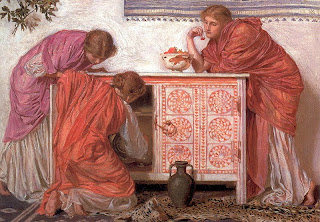
She also did a very strange class once which discussed the below Moore painting called Pomegranates in-terms of swirling vortexes of times (???):

They also have this rather fabulous early Holman Hunt, who is one of my favourite’s, and some really beautiful Alma-Tadema’s to name but a few:
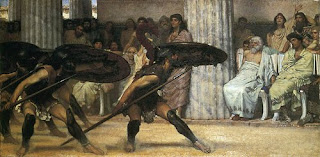
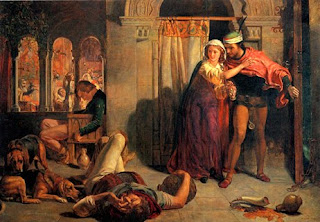


Last and by no means least is the very weird statue they have of Margaret Thatcher shoved into a corner upstairs, scary:
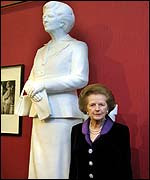
So, that’s the rather fabulous permanent collection, now onto the exhibition. I have been to see a couple of really rather fabulous shows at the Guildhall in the past, most notably the Watts (more on him later) last year. I have to admit, however, that whilst very enjoyable the exhibition now on is somewhat… well, odd, frankly. Empire Mail: George V and the GPO, according to the website, looks at the passions of King George V, the 'philatelist king', alongside an extraordinary period of design and innovation in the General Post Office during his reign. Basically the point of the exhib was showing how the social and political history of this period is demonstrated through stamps and the development of the post service. So yeah pretty fucking random I think you’ll agree. Cool though, in an ‘I can’t quite believe I’m here but enjoying this anyway’ type of way.

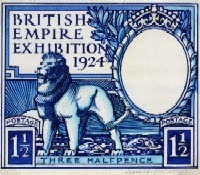
So, George V came into power on the anniversary of the penny black – i.e. the first stamp. He was an avid stamp collector collecting stamps specifically from Britain and the Commonwealth and his collection is now seen as one of the very best in the world containing several unique examples, or whatever. It belongs to the queen still who leant it to the Guildhall for this exhibition, how nice. For a stamp exhibition thankfully there seemed to be much fewer stamps on show than you would expect – which is definitely something of a relief. They had some of the rarer examples up including penny blacks, rejected designs for penny blacks, and things like the first stamp from elsewhere in the British Empire i.e. Mauritius. They also had designs for the first commemorative stamps which were for the British Empire Exhibition in 1924 (image at the top of this blog). Embarrassingly I had basically never heard of this one – The Great Exhibition yes and the Festival of Britain yes but nothing in between oops! The British Pavilion was turned into Wembley stadium though so there you go. Apparently the post office had it’s own pavilion along with a special mail service within the arena it was all considered to be so so important.

The rest of the exhibition was rather more interesting than all these stamps with lots of rather amazing blown up photographs of various things. One room was all about the postal service during the First World War and how important it was for the troops etc. They also had info about the Post Office Rifles which was a battalion made up entirely of postman and people who worked for the post office. Employees were actively encouraged to sign up and get their brains blown out – it was so popular in the 1st world war that they had to create a new division, or whatever military word you would use for this. They also had a section about the Suffragettes who had a big old relationship with the post office I knew nothing about, apparently seeing it as “both a means of mass communication and a symbol of the oppressive male Government; as friend and simultaneously foe”. They often vandalised post offices and poured tar, treacle or acid into post boxes as well as attempting to mail themselves to 10 Downing Street at one point as human parcels for the attention of the PM.

Appropriately, given the theme of the exhibition, George V was responsible for the worlds first scheduled air mail flight as part of the celebrations for his Coronation in 1911. A flight was arranged between Windsor and Hendon and postcards which could be sent on this new revolutionary post service were distributed in the local Windsor paper. This, alas, only happened once and it wasn’t until 1919 (ish) that it properly started. I guess air travel was still unbelievably expensive at this point, even for the mail. They also had an example of old school post boxes specifically for airmail which were a regular site in every town in the country until they changed the way it was collected, or something.


The exhibition then moved onto slightly more aesthetically pleasing ground and we had lots of lovely examples of 1930s poster art. This was due to the appointment in 1933 of Sir Stephen Tallents as the first Public Relations Officer for the Post Office. He set about a pretty impressive advertising and PR campaign and also started a competition to design a logo, apparently an early example of branding. He commissioned some of the best artists of the day to create beautiful posters such as the below:

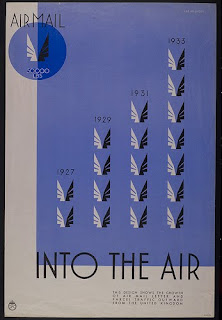
Kenneth Clark of the National Gallery, amongst other luminaries, was part of the selection committee for these, he was also on the committee that judged the entries in the competition to design the official stamp for the British Exhibition in 1924. Artists who were invited to contribute to that competition included Edward Dulac, one of my all time favourite illustrators!

Below is a poster by Vanessa Bell designed to encourage people not to leave their posting until the end of the day to save crowding, unfortunately it was felt to give the wrong type of message and was rejected!

Tallents was also responsible for setting up the GPO film unit who produced numerous films advertising the postal service, some of which were specifically for educational purposes in schools and churches but they also produced news reels and perhaps most importantly the film Night Train which had a general cinema release.
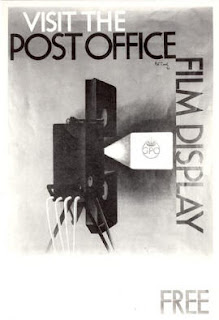
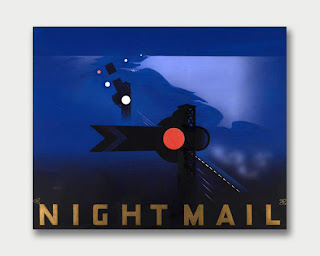
This hugely popular film celebrated the overnight postal trains which were used to both transport the post and sort it on the go. This film is thought to be responsible for putting British documentary making on the map and was hugely successful. W H Audin’s famous poem Night Train was based on the film and below is a link to the poem in case you would like to read it again!:

http://www.tynelives.org.uk/stephenson/poem.htm

For all those who enjoy poems about trains here is another FABULOUS one which was a favourite of mine as a kid – read it it’s really good!!:
http://www.poemhunter.com/poem/from-a-railway-carriage/

They also had a very beautifully illustrated/printed version of Audin’s poem on show which alas I can’t find online. A hugely popular poster was also produced around this time to advertise the night train service. Bastard Guildhall refused to make this into a postcard and instead I had to buy it as a greetings card which cost me more than the entrance fee to the exhib annoyingly:
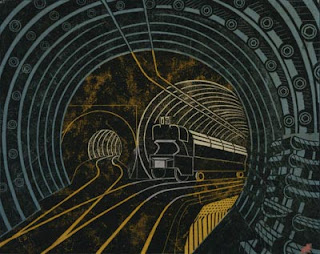
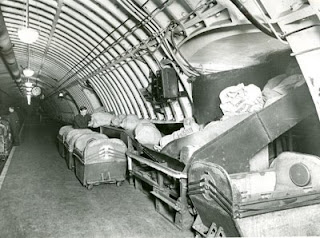
There was some other groovy stuff on show such as the first postal vans from the 30s and the first delivery motorcycles which were both very shiny, sort of thing men who collect stamps would very much enjoy. There was also some cool info about the London underground mail railway which I have always found very mysterious, romantic and exciting:
So, it was a very enjoyable if very random experience but in general go to the Guildhall as it’s great and always empty!

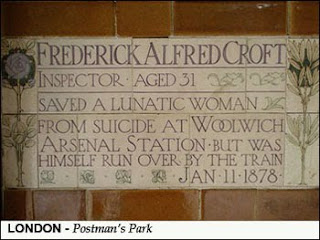
After we had left Sam took me to see a very strange monument that I can’t believe I had not known about before. If any of you have seen the beyond awful film Closer you will recognise it as being in the park Jude Law and Natalie Portman meet in at the beginning and if I remember rightly the end of the movie. For some, highly coincidental reason it’s called Postman’s Park and it contains the weirdest thing I have seen in a while. Conceived by the fabulous Victorian artist Watts it’s intended as a monument to people who sacrificed themselves to save others in every day life. This is intended to inspire us all to be more heroic and get killed trying to save other people. It’s a series of painted tiles, probably about 30 or so, along this random bit of wall and each is dedicated to one of these ‘everyday heroes’. Most of them seem to have drowned saving unfortunate people, or people more fortunate than them it turns out, some of them burnt to death, a few fell into wells or in front of trains. Seriously morbid stuff – high, HIGH Victorianarama. Love it! My favourite has to be to the man who died of exhaustion having saved people from the ice on Highgate Ponds, one of my favourite spots in London, the one below is also pretty good:
That’s all folks!

Tuesday, 15 June 2010

Week 21: Christen Købke; Danish Master of Light/National Gallery


Good afternoon fellow cultural pursuers. I am running slightly behind with my blog this week once again due to excess amounts of work and continuing mental and physical recovery from vile and savage stomach bug which lasted ALL LAST WEEK. Having been imprisoned in my flat feeling like death for 6 days straight I am pretty impressed that I managed to do anything cultural this week at all let alone 2 things which is in fact what I achieved. I managed to pack a weeks worth of activities into one Sunday and attended TWO exhibitions and went to see a film yay me. On a side note you know something is seriously wrong with the world if you can see 2 different shows with pieces collated from across history and the globe for free then pay £15 to see Prince of Persia – WTF??? Was v entertaining though highly recommend it although not bloody Gemma Arterton or whatever she’s called who although very pretty with a healthy body image can’t act for shit.

Anyway, TWO exhibitions you say? Yes indeed-y. However, don’t fear I have decided to write about the first one only as I was slightly art saturated for the second – Indian Portraits 1560 – 1860 at the National Portrait Gallery – and definitely couldn’t do it justice. This is a real shame actually as it finishes in 5 days and was really rather wonderful – and free! – so recommend it to you all especially if you happened to see and enjoy (as much as I did) the Gardens of the Cosmos exhibition at the British Museum last year.

So, instead I will regale you all with tales of the now closed exhibition; Christen Købke; Danish Master of Light at the National Gallery. This was one of those admission free 2 room exhibitions they do which are about the perfect possible length for any exhibition – 30 mins, a trip to the shop and then you’re done – ideal. I attended with my fellow ex-courtauldian Nat who was similarly feeling his way blinkingly back into the light like me only his return to the real world was from a 2 month self inflicted architecture part 2 retreat. Poor boy. My previous weeks pursuit was accompanied by his lovely fiancé Emily so it was clearly the natural progression to go to this one with him. We both enjoyed it mightily.

Now, as usual I hadn’t really heard of Christen Købke before although was familiar with some of his rather beautiful paintings from elsewhere, although where exactly I am not sure worryingly. Here is a brief history of the man paraphrased from Wikipedia:

Christen Schiellerup Købke (1810 –1848), was one of the best known artists belonging to the Golden Age of Danish Painting. Købke, a national romantic, painted portraits, landscapes and architectural paintings. Most of his portraits show friends, family members and fellow artists and found most of his motifs in his immediate surroundings and produced work renounced for their harmonious use of composition and colour. Almost forgotten in his own lifetime despite praise of various contemporaries, Købke had never been inundated with commissions yet is recognized today as one of the most talented among Denmark’s Golden Age painters and the most internationally renowned Danish painter of his generation.

So bit bad that I hadn’t heard of him but fuck it I haven’t heard of anyone – that £75 Student loan repayment coming out of my pay check each month really is a cruel mockery. However, I do know a small amount about some of his contemporaries such as Caspar David Frederick – who I LOVE - and others, and can definitely make up a lot of almost plausible sounding shit from that which I will now proceed to do. I will also supplement this heavily with untrustworthy internet sources.

The Golden Age of Danish painting refers to the first half of the 19th century which if I remember anything would encompass both Romanticism and Realism – I think, both of which are ace. Købke’s work seems to tick both these boxes in various ways. He militantly studied and sketched from the real world taking highly detailed preliminary studies for his pieces which he transferred directly to the surface of the canvas. This was dictated by his tutor the great Christoffer Wilhelm Eckersberg who was enormously influential to both Købke and his contemporaries. Despite travelling to Italy on scholarships from the Danish Academy his subject matter also tends to focus on the mundane and everyday surroundings of his home – a citadel just outside Copenhagen, and his canvases are populated with figures from every day life; cigar sellers, milkmaids and small boys throwing stones to name but a few.


This idealised version of reality is sort of like the Danish version of official, salon-friendly French Realism such as the work of Jules Breton who created images of idealised peasant life, unchanging and unthreatening, satisfying the contemporary taste for images of ‘real life’ peasantry without the controversy of artists such as Courbet:


Contemporary accounts suggest life at a citadel was rough and seedy but this doesn’t come through at all in Købkes work which instead makes his ‘home town’ seem tranquil and harmonious, half deserted in a sleepy happy sort of way. We are presented with the perfect image of provincial Danish life, simple and balanced and unchanging and thus it’s easy to see why his work was considered to be national romanticism – imbuing the everyday with the noble and spiritual.


The image above and the one below demonstrate his use of highly emotive colour which he used to create an idealised version of the natural world which is much more in tune with Romantic ideals. The concept of the emotive, intellectual landscape was a highly Romantic concept – the idea of nature as sublime, a harbinger of both tranquil beauty and raw emotion is half articulated in works such as this which use a palate of pinks and purples to suggest evening light. The painting below; View of Dosseringen near the Sortedam Lake Looking towards Norrebro demonstrates this. The painting seems ambiguous – is this boat returning or departing, what is the relationship of the women
waiting on the quay and what is the significance of the Danish flag etc etc?. The pink water lends it a sense of the unreal; dreamlike and contemplative. We feel like this is a wistful image, the landscape subdued, reflective and thoughtful – a Romantic landscape.

It is really with his portraits that Købkes work seems to be more ‘Realist’. He tended to paint friends and family more than anything else, mainly because he didn’t receive many commissions. Instead we get images such as this of his own mother, a decidedly un-idealised image of a busy slightly careworn house wife (and apparently mother of 11!)


He also did a series of ‘character portraits’, which alas like usual I can’t find images of, which are rather beautiful and show the wrinkles, frowns and general un-idealised reality of everyday people. There is this fabulous one of a baker with pretzels and a cigarillo with most of the buttons in his flies undone hhahahaha – Købke grew up on the citadel because his father was master baker so there is a real sense of the familiar and affectionate in this pic:

As well as these he did several portraits of fellow artists such as this fabulous one of Frederik Sødring with whom he shared a studio – love love love this pic it’s totally fab sexy and informal and I love the way you can see their different artistic stimulus and inspiration in the fragments stuck to the wall behind him such as prints or sketches of cows – very Danish. Doesn’t he have a nice face!?
Last but by no means least the exhibition had a fabulous array of his architectural pieces – especially those based on Frederiksborg Castle which he painted numerous times from various, increasingly daring viewpoints.

The castle was a national landmark and was being rediscovered at this time by writers and artists as a relic of Denmark's glorious history. Here Købke really excelled in his depiction of light, space and a sense of endless flat Danish landscape dominated by sky – empty and epic. Here he shows an ability to use daring angles which turn the monumental castle into abstract shapes and planes of view. So minimal, classy and fabulous wish to own one of them BADLY!! And on that note I sign out for another week – stay classy San Diego.

Monday, 7 June 2010

Week 20: Exposed; Voyeurism, Surveillance and the Camera/Tate Modern


Dear all

So should be doing work but back on track with the one a weeks for once woohoo. This week thanks to the lovely Emily I was organised enough to do something cultural on Friday evening after work which was very civilised indeed (for me) and meant that for once I didn’t have a mad rush on Sunday afternoon to find something close, cheap and not too intense to do on a hangover! Instead we went to the Tate Modern with the other cultural people who think to go to late opening and we even had drinks and olives on the terrace of the members bar yippee. One day I really must join the Tate rather than just using everyone else’s membership as the bar is almost worth the price of the annual ticket alone, well almost.

The exhibition we went to see was Exposed; Voyeurism, Surveillance and the Camera and it’s on til October if any of you want to see it. I had the joy (for me) of approaching this exhibition without a clue what it was about which is always fun. In fact, I didn’t event know what exhibition we were going to see until just before and haven’t been keeping in touch with what is currently on at the Tate, or anywhere, so this was all a total surprise for me which I think always adds somewhat to the ‘gallery experience’. Interestingly enough Emily is a fellow blogger and I imagine will be writing about this too so it’s almost as if we are voyeur-ing each other!! Am sure she will have much more interesting things to say – I will stick to a quick over view as haven’t got enough time to think of anything intelligent or thought provoking to say!!!

Now, let me preface with a slight, or massive actually, prejudice I have against photography exhibitions. Basically, I firmly believe that any bloody photograph when blown up and put in a nice frame (or preferably a light box) on a white gallery wall looks impressive. Any shit snap-shot I could take from this weekends barbecue would suddenly look a hell of a lot more impressive, meaningful and thoughtful if I paid to have it reproduced nicely and put in a museum space. This is why I am usually not that interested in photography exhibtions – because any moron can aim a camera at something and produce a half good image. Let’s not forget that photography was invented by a frustrated artist. This sounds like a massive diss, which it is, I just don’t think photographers are as talented as any other ‘artist’. Sorry!! However, that doesn’t mean I can’t enjoy mightily a photography exhibition – especially ones with old-school images in like this.

So, this is what they have to say for themselves on the website:

“The UK is now the most surveyed country in the world. We have an obsession with voyeurism, privacy laws, freedom of media, and surveillance – images captured and relayed on camera phones, YouTube or reality TV.”

This may be a slightly obvious theme but I found it interesting none the less. I find everyone’s hatred of surveillance in this country deeply irritating because they complain and complain and complain about it yet when someone gets mugged/kidnapped/murdered or whatever it’s suddenly the best thing in the world and people just cant understand why that dark alley behind the back of Tesco wasn’t properly filmed – you can’t have it both ways idiots its either a nanny state with the benefits or not. I find it quite comforting to know that I am photographed every 20 seconds or whatever it is – at least if someone tried to kidnap me the police would know my movements and frankly I have been caught doing a fair amount of naughty things on CCTV and never been arrested etc so all good really. I did have an ongoing fantasy about throwing a brick through the window of my ex boyfriends brothers bedroom for a long time which was only stopped by the fact that they lived on a main road with loads of cameras up and down it – but that can only be a good thing surely???

So, the exhibition charted the use of photography as a ‘weapon’ of surveillance, control, knowledge, etc. They began in chronological sequence (sort of – if you ignore some of the REALLY awful pieces in the first room – a collection of ugly people photographed unawares in front of blacked out backgrounds – yeah great shakes rah rah rah). So, we had some nice pics from Walker Evans's Subway Passengers series which seem to get trotted out at almost any photography retrospective like, ever, but I haven’t got any problem with that as they are quite good.


They also had some really cool examples of hidden or trick cameras which were really fascinating – cameras hidden in the heals of shoes or the top of walking sticks etc. Clearly the covert observational aspect of photography was realised pretty early on – most of these examples were from the 1890s/1900. The photographer Paul Strand used a special camera with a false lens at the front and a real one at the side to capture the poverty stricken of New York while off guard – which is mean; if you haven’t washed for 2 weeks it would be nice if someone asked your permission to preserve you in celluloid history for 100 years:


There seemed to be a hell of a lot of focus, especially at this point in the exhibition, on New York which I found interesting, I don’t really know why that was though!!

This was the part of this exhibition I personally found most interesting as, at this point, photography was relatively new still and it provided a totally revolutionary way of seeing the world – which I find interesting. Before this, if you think about it, EVERY image was highly curated in one way or another. This is the first time people were viewed unawares, out of their own control and in a spontaneous light. In short a totally different way of viewing people and the world. Somehow though these images are never viewed or discussed in terms of their intense smugness. I understand the photographers desire to shine a lens on the worlds inequalities and destitution, but to do so without the subjects permission almost feels as if it is the ethnographic, racist eye of the colonial conqueror – viewing these people as specimens from a different world who don’t have the right to control their own image, identity or voice. This is why I quite like the below work by Lee Friedlander for both it’s sinister appearance and focus on the more day-to day middle class domestic space – a preened modern women walking the streets of New York ‘alone’ rather than the destitute masses lining up for work. Again though – if this was in your photo album in colour rather than back or white you’d probably think it was bollocks.


The next couple of rooms dwelt on something I will forever find fascinating – the cult of celebrity and in this case how paparazzi, and non paparazzi photography helped to feed this. There was an AMAZING one of Degas coming out of a public toilet in the 1880s by Giuseppe Primoli hahahahahaha!!: They had some pieces by the photographer Ron Galella who obsessively followed and photographed Jackie Onassis until she got a restraining order against him, the birth of the modern concept of celebrity hand in hand with the modern concept of ‘talent’ ego – although you do have to feel sorry for her she was the first of many! I could go on about paparazzi and celebrity for days I really could but don’t worry I wont I realise no one is as interested in this as me!

There were several rooms about sex and voyeurism etc but to be honest I found this the most disappointing part of the exhibition – this is just too big a subject to fit into 2 rooms, it needed a whole separate exhibition to do it justice and I really can’t be bothered to go into this at all which in fairness is because I am lazy and have actually got to do other things today. I did find it amusing that all the little rooms where they screen films were empty apart from the one coming off this room which had a sign saying ‘over 18s only this film has extreme sexual content’, or something, and it was absolutely packed!! I couldn’t even get in there but I am pretty sure it was that series by Nan Golding to which I can only really say SNOAR. I found those images quite touching and interesting until the age of about 21 when I realised they were pointless and empty and she is beyond self involved – it’s just not funny. Maybe if my boyfriend beat me up and all my friends died of aids people would want to see my photos too but I hope to god I don’t find out. There were some great pics taken inside cinemas with people snogging which were great though:


For me one of the more interesting sections of the exhibition was that entitled Witnessing Violence about images which we as viewers feel that we should not really be witnessing, scenes that are too personal or that we are intruding on as outside spectators. This includes war photography as well as more personal stories such as a really harrowing series of images of potential suicide victims, crowds on the street below watching in morbid fascination to see them jump. There was a HORRIBLE set of 2 which unfortunately I can’t find images for with a man about to jump from the 8th floor of some building in Johannesburg, or somewhere. There are 2 shots – one of him looking back to camera from his perch absolutely terrified with mad eyes and the other of him jumping. Apparently crowds below were shouting ‘jump jump jump’ as someone was trying to talk him down – fucking chilling. Anyway I have to do some work but definitely a worthwhile exhibition to see! See ya later bitches x

Friday, 4 June 2010

Week 18 and 19: Chelsea Flower Show & Karaoke

Dear not forgotten cultural pursuers,

I can only apologise for my recent lengthy absence from blog land – work has been so horrendous for the last few weeks that I have been forced to work like a dog and alas my cultural pursuits have somewhat fallen by the wayside!!! It’s like the BBC is actually expecting me to work for my pay check for once and I really can’t deal with the pressure?! Anyway, because of this (and frankly my intense laziness last weekend) I haven’t really had a chance to either do or write about anything intellectual for the last fortnight, so, in an effort to keep up with my new years resolution I am now going to give a quick recount of recent “enlightening experiences”.

Number 1: (Week 18) Karaoke CHINESE STYLE!!!

Last Tuesday my delightful friend Diccon celebrated his 28th birthday. Ahhh. Lovely Diccon has spent many years of his (now not so)short life trekking the sands of foreign lands eventually to wind up back here married to a delightful Taiwanese gentleman called Hans who organised the birthday celebrations I am about to recount.

Diccon, as well as being some kind of linguistic savant is also rather a good singer and clearly embraced the chinese/taiwanese/whatever love of Karaoke and pop music to its full. Frankly I would have judged him if he hadn’t. He even appeared in a pop video for one of the biggest groups in Asia at the time - how cool!! For his stag-do last year I organised home karaoke and we had a very enjoyable evening getting wasted and singing along to fab pop music.

Now, some people, I believe, tend to misunderstand karaoke. They think it involves standing up in front of bars full of people and singing a song all by themselves as everyone judges and ridicules them. I’m sure this is the case in certain situations but I, a true lover of the art, have luckily never been faced with this difficult terrain. You see I passionately love singing, it just doesn’t love me back. Cats have died in a more melodious fashion but not once has this stopped me from not only enjoying singing, with all my heart, but enjoying karaoke mightily as well! This is not only to do with the advent of the private karaoke booth – a fabulous concept – but also the fact that karaoke isn’t about singing by yourself but about big old group sing-alongs whilst fucked where you all join in in one great inharmonious screech.

So, karaoke was clearly the name of the game last week and my friends, we were in the know! No Luckyvoice bullshit in Soho for us we were off to the random and inhospitable waste land of Hampstead road near Euston to a strange and uninviting buzzered door of some seriously hard core Chinese karaoke bar – this thing was full on. It would have been pretty much impossible to go there unless you either spoke Chinese (or Cantonese /Mandarin or whatever) or were with someone who does as, for example, all the machinery in the rooms was in kanji and the vast majority of the music they had was proper job Asian pop which, therefore, as an English speaker was pretty hard to sing along with. Not that this dulled my enjoyment in ANY WAY. Diccon and Hans and there friends did a damn fine job of the Asian pop while I stuck to the old karaoke favourites: Britney, Madonna and Beyonce with a healthy dose of Gaga for good measure – a women whose karaoke potential had never been fully registered by me until that night.

Diccon explained that in Taiwan they have special seats in the karaoke booths to allow you to sit down normally or to perch above with your feet on the seats to aid vocals. In each of the rooms and the bar upstairs they had that Chinese dice game that is a major drinking thing over there – I have played it several times with Diccon and Hans as I too am in the know and attuned to Asian culture. It involves cups and dice and guessing how many numbers everyone has then you drink when you’re wrong. The cocktails were WEIRD but my particular favourite had to be Yakult and vodka. Am not sure if this is a traditional karaoke drink but I think it MAY have been and it went down surprisingly well – try it it’s very refreshing for the summer!! They also had smooth white empty plates supplied in each room….enough said.

No 2: (Week 19) Chelsea Flower Show

So, that was the week before last. Last week, on Friday, my new(ish) flatmate Justin got me and a friend tickets to the Chelsea flower show as he has been working on the red button stuff for the BBC. It was ace. For one thing I took the day off work which is always AMAZING. Everyone else had to pay £50 for a ticket or somet and queue but we got them free and got to go in the special press entrance and then some annoying posh women behind us tried to get in too and weren’t allowed HAHAHAHAHA!!!! This took us directly to the production area where we got to hang out by the BBC porter cabins and get in the way. This may not sound that exciting but it WAS as for one thing I found out the BBC have a competition amongst the different Chelsea crews every year to see who can blag, borrow or steal the best selection of plants and flowers to decorate their porter cabin with. Then, at the end of the week Alan Titchmarsh judges them all and whoever wins gets a prize!!! Justin my flatmate got gold this year although apparently not best in show – which I would have thought IS gold but apparently isn’t. He managed to blag some sort of crab orchid or something which only flowers once every 3 million years – or something.

Well, Chelsea Flower Show – as a kid I use to watch this every year on the tele with my dad who is very into the gardening. I always always wanted to go until I attended a different flower show somewhere else with the parents, and almost died of boredom. It was MASSIVE with about 400 marquees going on forever filled with boring plant after boring plant and more gross dried flower arrangements than a normal person would think could possibly exist in the world. I have felt funny about dried flower arrangements ever since – or dead dust collectors as they are known in my head. From that day I went off the idea of attending Chelsea dramatically as I assumed it would be an endlessly dull as that was. However, it turns out that for one thing its pretty bloody small. I always wondered how they managed to squeeze so much into the relatively small space of the Chelsea Hospital but now I know how = it looks much bigger on the TV. This was definitely a good thing as frankly I only wanted to see the show gardens anyway and then maybe have a quick look at some pretty roses or somet and certainly not spend all day elbowing my way through hoards of ‘mature’ white middle class women. I am glad we went later in the day in general actually as it was packed yet apparently ‘emptying out’ in comparison to earlier – must have been manic.

There were something like 15 show gardens, although some of them are TINY – which again doesn’t come through on the TV at all. I have to say also that in comparison to my TV memories of old most of them were beyond horrendous. There was one which, although definitely cool wasn’t a bloody garden at all it was a swimming pool and looked like something from the outdoor bit at Homebase!! Chelsea flower show is not a place to advertise the latest collection of DFS tiles is it?? Not that I am not a huge fan of tiles and all but really… That was the Australian garden and in fairness other than a few dried out looking palm trees and rubber plants (or something) what the hell else are they going to put in gardens in Australia they can’t water anything. Although thinking about it an entire garden made up of pool is surely not great when you have a hose pipe/water ban which surely they must get A LOT. This garden was given gold???


As if this wasn’t enough the Children’s Society was even worse – it was the size of a table and consisted of a cold plunge pool and a barbeque and garden shed combo.


This brings me on to my main observation of the show gardens in general which was that apparently these days you aren’t allowed to have a garden at Chelsea without some sort of major architectural summer house construction in it and apparently those constructions have to be completely boring and all look exactly the same. Apart from a few exceptions they were all made of some sort of SOLID looking metal, usually artfully rusted, and no more than a bus shelter in design. This always, ALWAYS, seemed to contain 2 fancy metal chairs that clearly weighed about 30 tones each. Then there were some plants fitted in around it. LAME and tasteless beyond belief frankly. There were a few that bucked this trend; Leeds City Council did a damn cool one which was based around a canal lock with ‘naturalistic planting’:


But even here I couldn’t help feeling that even this one was pretty damn naff really – I mean it was a fake lock, with fake spurts of water coming out of it etc – it all just felt a tad ridiculous and beyond vulgar in its fakery. Vey Fanny Cradock. Ironic when it’s a celebration of plants and flowers etc – i.e. nature. But then it occurred to me that this was as far removed from nature as its physically possible to be. Which is kind of weird if you think about it.

However, the most hideous show garden of them all, and believe me some of them were horrid, was the Foreign & Colonial Investment Trust garden – this thing was a study in ugliness. I didn’t know until afterwards that it was supposedly based around Candide by Voltaire, a book I always feel very fond of and I really rather like the idea of being inspired to ‘tend your own garden’ at Chelsea. However, it was truly disgusting. For example; the fake stone wall along the side had the most disgusting collection of bronze statutory I have EVER SEEN – and that’s saying something. Awful, AWFUL sculptures of nude women with various arms or tits looming out into the garden space. So, so hideous. This is what they had to say about it:

The field-like layout of the garden is suggestive of the Turkish smallholding
where Candide’s final words are spoken and the planting adds an appropriate
Mediterranean flavour. The two pools represent the oceans that Candide crosses
in his travels linked by a scalloped flowform designed to mimic the rapids of the
river that shipwrecks Candide’s canoe upon entry to El Dorado. Stone-clad and
planted walls represent the steep cliffs that surround El Dorado. Love interest
Cunégonde and her transformation from coquettish girl to social climbing
courtesan is depicted in the sculpture series as Candide’s lusty ‘thought bubbles’
in his trans-global pursuit to have her. With the addition of furniture and pots
this becomes a feasible garden that could easily be found in the warmer parts of
the UK and it demonstrates new possibilities of exotic plant use due to recent
climate change.

Whatever, even the flowers they chose were ugly but clearly it was considered so foul by everyone else also that I can’t find any pictures that ‘do it justice’!

All in all though I very much enjoyed the whole thing and am more than glad I have been able to go finally – hopefully will be able to go next year also when garden design has moved on a stage. Lawns aren’t very fashionable any more are they? I like lawns, I like reclining on grass, a garden just isn’t the same without it is it??

Monday, 17 May 2010

Week 17: Enron/Noel Coward Theatre


Morning morning, although actually it’s very soon to being afternoon. I am finding it quite difficult to sit down and write my blog this week, mainly I think because the cultural activity in question took place last Thursday and my god am I expected to remember anything intelligent from 4 days ago??? I can’t alas, physically can’t so apologies in advance for what I am about to write, it’s always bullocks anyway so no biggie. I’m also in the process of attempting to eat porridge, or cum of the devil as it should be known, as my wisdom tooth is once more causing me issues so my take on Enron may become increasingly soured as this write-up progresses.

Right, last week I had the great fortune of being invited by the lovely Zarah to see Enron, a production currently running at The Noel Coward Theatre. These tickets were a gift to the lovely Zarah from her brother and luckily for me the boyfriend had a prior engagement so she invited me instead!! Yay for being the back up plan to boyfriends! Anyway they were basically the best seats I have EVER HAD at the theatre, usually “preferring” the cheapo scabby tickets with restricted view in the gods or whatever. Here we were second row from the front in the grand circle and I had an aisle seat so my knees weren’t in blistering pain from the first 30 minutes onwards!! The man with the largest head on earth sitting in front of me and squirming throughout is not going to get a mention – I hate him too much and his big fat retarded meat head doesn’t deserve any more of my time. What a pretty theatre the Noel Coward is though, can’t remember going there before, although in fairness the view is probably very different 50 foot up at the back. Also the whole experience is just so different in the posho seats – for example I walked straight out and into the nice loos in the foyer rather than having to queue for the entire interval outside the typical 1 cubicle provided for the chavs upstairs. AND, it’s been so long since I have been to the theatre as opposed to the opera or the ballet that I forgot you can take booze in there with you. Bonus!

Enron is the contemporary play/music dance spectacle charting the rise and fall of the energy company Enron, which collapsed at the beginning of the naughties due to massive amounts of fraud. Now, I know lots of appropriate sounding phrases and terms about finance and fraud and stuff but clearly I don’t know the accurate meanings of any of these terms and it would be no doubt rather unwise therefore to start using them now. So, in advance, apologies for my horrendous layman’s language or complete avoidance of any appropriate sounding classifications as I am clearly not going to get the intricacies of this situation. However, the play did do remarkably well at simplifying the facts for the tiny minds of people like me, at points perhaps glossing over things or leaving quite big holes in the audiences understanding, I suppose just because it gets too damn complicated.

The production was a mix of straight drama/comedy with some chorus style singing and dancing, again in a rather comedy fashion, and definitely not as much as I was lead to believe there would be. I would definitely class this as a play above any kind of musical or sound experience or whatever crap the press want to define it as. There was also a certain amount of video footage of things like the Bill Clinton sex scandal, the election of Bush, the fall of the twin towers etc, although at no point would I say this made it a ‘video experience’ as defined again by the press material. I wonder if all the hyped ‘singing dancing extravaganza’ stuff is partly why it apparently received such rubbish reviews in New York as opposed to its reception in London. If I went there expecting a polished musical satire I would have been disappointed. There was very little of the singing/dancing for one thing and the pieces they did do, although I felt successful for what they were, weren’t overly original or, well, polished. This makes it appear as if I didn’t enjoy these segments, which I most definitely did, in fact I probably could have done with more of hem, but I think if you make the choice to do things like that you should fully commit and do it all the way, not just a token dance scene at the beginning and one half way though or what have you. Make it a full on musical spectacular – that doesn’t mean you can’t also have the straight stuff as well. I also think these not un-crude pieces would have seemed even more underwhelming on the Broadway stage, which in my head is always twice as big as anything on at the west end. This production needs a small setting so as not to become dwarfed, it feels pretty intimate and I think it would have appeared jarring on a larger scale.

So, the story; It all begins at an office party where the central character Jeffrey Skilling is introduced as a new recruit for the company Enron, based in Huston, Texas. He is very upset about people not understanding something called mark to market, why I don’t know but hey once again the writer did a damn successful job of explaining it in a coherent and simplified manner for me to be able to understand with my more than shoddy grasp of finance! Thus begins a seemingly short lived power struggle between Jeffrey and Claudia Roe, another high flyer in the company. Claudia wants to continue building power plants and pipes, producing the oil and gas which made the company big. Jeffrey wants to make it an ‘energy’ company, ditching the production and instead building a trade floor. If I understood business, finance or in fact anything at this point I would carry on but I don’t so I won’t. Jeffrey and Claudia are also shagging, although as their rivalry increases that soon stops. There was a particularly odd line near the beginning after they have been doing it on the desk – they talk about the future of the company, about how Ken the president or owner or whatever was soon to step down and appoint a new president. At this point Claudia requests a tissue from Jeffrey as she ‘appears to be leaking/dripping’?!?!?!!??!?? WTF???? I think they were attempting to set the quasi-comedy tone.

Time goes by, Jeffrey becomes the golden child as stock prices soar and Claudia is gradually beaten to the sides, still stuck in the pre Jeffrey company mind set. Jeffrey sees the future and it is greedy. He sees there is money to be made but his company, priced on high hopes and expectations is failing to make the money that is predicted and is slowly sinking into debt (I think). Step in the nerdy deliberately putrid character of Andrew Fastow, soon to be made CFO, who comes up with a genius way of hiding the bad debt through financial loopholes – namely the creation of a fake company made almost entirely of Enron shares, or stock or whatever it’s called, to swallow the debt. As long as the share prices don’t slip, for some reason, then everything will be fine forever!! (yeah right). Locked in his increasingly dank and gloomy basement the character of Andy becomes more and more that of the crazy mad scientist, alone with his freakish Frankenstein style creations which are slowly starting to take control. These fake companies are represented as weird dinosaur type creatures who skulk around creepily with demonic red eyes. As the play continues their presence becomes more and more sinister as Andy continues to feed and pet them, referring to them like his babies, mourning for them as they get increasingly sick, fed too many bad shares.

The hey-days are becoming an increasingly distant memory as paranoia and fear start to creep into Jeffrey’s mind, Ken knows something’s up but doesn’t want to know too much, Claudia is long gone on a train of bitterness and recrimination, the wolves are drawing in and he knows it. A seemingly disastrous foray into the now deregulated electricity market in the state of California leads to rolling black-outs and share prices slowly starting to drop. Jeffrey quits but it’s too late, confidence has been lost and post 9/11 the company crumbles revealing the massive fraud and resulting in Jeffrey, Andy and Ken being sentenced to long spells in the big house – 25 years for Jeffrey which as Zarah LOUDLY whispered next to me is the same length of times as murder, which is worrying on multiple levels really. The last scene is at the funeral of Ken, who it is implied killed himself before he could be properly sentenced. Claudia is there, gleeful that the only part of the company found to be worth anything was her division, and we get a slightly clichéd graveside widow–style scene with a poor lowly worker encouraged to sink all her money in Enron shares berating Jeffrey on ruining her life etc. For me this is where the play started to go down hill slightly but as that was about 5 minutes before the end that’s not bad. It was cliché to say the least and the humble headscarf sporting lowly female worker could easily have been left out and replaced with, for example, the security guard who figures earlier in the story, and would have been a hell if a lot less corny. There should have been a less melodramatic way to express the personal hell of thousands of people who lost money in the scandal. The ending provided one last soliloquy for Jeffrey, lamenting his own sense of greed in a greedy world etc – no shit!! Talk about obvious point to make! A far more revealing statement occurred earlier when, asked if he took advantage of the situation with deregulated electricity he scoffs in disdain and asks am I a man? - of course I took advantage of the situation, that’s what business is! I would like to re watch the last 10 minutes or so as I always find it difficult to concentrate right at the end and I feel the speech he made at this point needed more thought, by me and the writer!

The play was staged, I believe, very well using lighting in a fun and imaginative way. I particularly liked the first rising then dramatically falling shareprice displayted on the sur-title screen above the stage, acting like an omnipotent god controlling all that occurs beneath. There was a scene with light sabers which I enjoyed greatly and in general it was, I felt with my limited experience, well staged. There was one quite good speech at the end given by one of the women who valued the company – an analogy of the stock market as an airplane. You don’t know how it works but when you get on you assume it will – kind of my understanding of finance, or was until a few years ago when everything started to crumble about our international ears, but not the kind of thing you want to hear from someone who supposedly knows what they’re doing!! At the end it said that many of the processes employed by Enron are now used in companies around the world, in which case why were they all sent to jail? Anyway, a very enjoyable experience – good luck getting the pricey tickets me and Zaz enjoyed though HAHA.

Monday, 10 May 2010

Week 16: Victoria and Albert Art and Love: Queens Gallery

Morning morning and what a bright and sunny Monday morning it is. I am still recovering from the fact that it took me 55 minutes to do a 15 minute journey into work, much needed chain smoking session will alas have to wait til nearer lunch. This week everyone wanted a piece of my blog but alas, for them, they couldn’t have it. After the disaster that was last weeks pursuit this weekend I decided to treat myself to an exhibition I have been looking forward to for ages, and in order to get my enjoyment max I decided to go it alone, free from distractions or the pressure of rushing – in the end I was in there for over 2 hours which for me is very good, usually I can take about 45 minutes of art and I’m done for the day.

Victoria and Albert Art and Love was even more amazing than I could have hoped. It was so amazing in fact that I’m not really sure I can face writing about it, it was just too good – what will I say? Other, maybe, than GOLD GOLD GOLD GOLD GOLD GOOOOLLLLLLLDDDDD!!!

Well, to start with the mundane, as always, I was v pleased with myself for my economising ways. I went to see an exhibition on Conversation Pieces at the same gallery a few months ago, in fact I believe it was my FIRST cultural pursuit, and paid about 6 quid to get in but as I remember commenting at the time that ticket entitled me to free entry to any of their exhibitions for the next year! I am very impressed with myself that I’ve actually managed to hold onto the ticket, which has been loitering in my rolling tray for the last 3 months, and was able to get in free to this exhibition even though it cost over £8!! Bargain!! Also their, excellent, audio guides are free unlike shits-ville V&A which charges for them on top of their exorbitant entry fees. And they would probably be crap there anyway.

So, as you may have worked out by now I rather like the Victorians, in fact, frankly I don’t think I’d mind that much if civilisation had just mysteriously bored of art post 1900 and just left it at that. So, an exhibition focussing on the trend setting art and objects collected by the royal couple is exactly my cup of tea. However, as much as I love Victoria, the star of this show is undoubtedly Albert, who it turns out was a bit of a dude! This exhibition really highlighted what an incredible, trend setting, enthusiastic and educated man he must have been. I knew, for example, that he was heavily involved in the Great Exhibition of 1851 (I didn’t even have to look that date up rock on GCSE History know-how), but what I didn’t realise was how completely and utterly it was his brain child, and how responsible he was for basically ever aspect of the show! I also didn’t realise he was one of the first to study the new academic discipline of art history and the exhibition had a small room focussing on the early art that he particularly enjoyed collecting before his marriage to Victoria. For example he had 2 beautiful Cranacks which he brought with him from Germany, an artist who I have always loved, and was in some way responsible for popularising his work during the 19th century. Albert’s influence seems to have stretched so far that I start to ponder where the world would be today without him. It was he after all who was mostly responsible for building the cult of Christmas in Victorian England which affects not only the way we view yuletide to this day but impacts on concepts of the family, the home and childhood in general. Victoria was undoubtedly interested in art and collecting herself, she was it turns out a not untalented watercolourist, but it seems to have been Albert’s influence and tastes that really inspired her to commission and buy particular works of art. For example; she had this painting of Albert’s favourite dog painted for him by Landseer as a present, and it was through their patronage that his career really took off


This was also the case for Leighton, who had one of his earliest works purchased by the royal couple (pictured below) and, of course, went on to be one of the biggest artists of the 19th century, no doubt partly due to their patronage. This work, and many others owned by the couple, was bought directly from the walls of the Royal Academy exhibition. How amazing to go to the summer show and just pick anything you wanted. Apparently Albert often had ‘useful’ advise for the artists he patronised, although who knows if he actually just got in the way and made stupid suggestions which they had to pretend were good because he was appointed by god etc? For example, there was one John Martin work in the exhibition which was commissioned after Albert had seen The Deluge, now in the Tate. He suggested Martin make this piece into a 3-parter with one piece set after the flood and one before called ‘the Eve of the Deluge’, probably just so Albert could then buy it at no doubt vast sums. I have to say though that in comparison to the Deluge it does somewhat suck.

Of course, according to the audio guide the couple did have to practise economy throughout their reign in terms of their patronage of the arts. In fact poor old Victoria had to limit herself to spending only 2 grand a year on art and a lot of her budget had to cover the pictures that Albert wanted to buy. In fact, when discussing the Leighton Victoria commented that Albert ‘simply had to have it so I bought it him’ (to paraphrase). It did make me think; this man was a massive patron of the arts needing to sustain a ferocious appetite for buying art, had to be granted extra money from Parliament to be able to entertain on an ever grander scale, picked and styled his wife’s clothes and jewellery, LOVED costume balls, of which there were many throughout his time as Prince, had an important hand in the building and decorating of their various residences etc. Hate to be the one to say it but has anyone ever thought about just how gay this guy was??? Anyway, just something to chew on there…

His apparent gayness didn’t stop them squeezing out about 300 children of course and it is the family portraits that are really the focus of this exhibition. Entering the gallery they are the first paintings the visitor experiences and the central painting, curatorially and in terms of merchandise is Franz Xaver Winterhalters huge portrait of the couple surrounded by their children probably set in their new palace Osborne House on the Isle of White. This, along with Balmoral, was viewed as their retreat away from public life in London. Winterhalter enjoyed very favourable patronage under Victoria with a seemingly huge number of commissions gracing the walls. He was particularly favoured by Albert who liked the Northern European style domesticity of his paintings as opposed to the previous more formal type of official Royal portraiture. His popularity and success was due in part to this need for a new type of visual representation of the Monarch. Victoria was the first ruling female monarch since 1700 and something. In her depictions she needed to be represented as head of the state yet place Albert firmly as the head of the family. In this group portrait Albert’s head forms the pinnacle of the piece, yet it is Victoria next to him who is sheltering the future heir to the thrown, here we see the royal line safe and unaltered. It’s is also key that there are no crowns or outward sign of royalty in this piece, riches yes, but this is very much a scene of a family at home not on public display. Of course ironically on its completion it was immediately put on show to vast crowds in St James palace, Victoria as ever grasping the full potency of royal propaganda.

The exhibition dwells at length on Victoria and Albert’s love of Scotland and their newly built castle of Balmoral, where they felt that thy could retreat from the stiffness of public living. There are two FAB paintings which annoyingly I can’t find on Google showing ‘Morning in Balmoral’ and ‘After the Hunt’ (or something) which illustrate this idea of the family at rest in their private domestic space. I also like the fact that the first one has a dated title, placing the royal family firmly in the ‘real world’ as a modern, loving family. To continue the new theory about Albert it was, apparently, he who insisted when there the servants wore ‘traditional’ highland dress and apparently he was much ridiculed in London for his adoption of the costume, mainly because he looked so damn fine in it. On display was the broach set with an ENOURMOUS and highly sparkly semi-precious stone that he used to pin his kilt over his shoulder. Huhhum. There was also jewellery particularly designed for wearing at Balmoral on show which was made out of stags teeth!! UHHHHHH


An interesting little room to the side showcased pieces from some of Victoria’s personal albums. These were albums she kept as keep sakes to be used in conjunction with her personal diaries. She was either given them by foreign dignitaries etc or commissioned artists to represent important places or events that she witnessed in her travels. They were of a strictly uniform size so that they could be bound together in albums and taken with her when travelling round the country or continent. This interests me greatly as it reminds me of my obsessive buying of postcards from every gallery I have ever been to and sticking them up on my wall, berating any establishment that doesn’t fit to the precise postcard dimensions as dictated by me. It also highlights the fashion for collecting and fetisising keepsakes, usually in a highly morbid way, during the Victorian era, possibly sparked by Victoria herself.
Some of the more interesting examples were of the Great Exhibition which apparently Victoria visited nearly every day for weeks. The exhibition also provided the couple with more opportunities to commission and buy work

The love of acquiring pieces that reminded Victoria of things she had seen and places she had visited was, apparently, extended to works she saw at the Royal Academy, which the couple visited every year. Here she saw Friths Life at the Seaside – Ramsgate Sands. I LOVE Frith, the Where’s Wally of the 19th century, and I didn’t realise this piece was purchased by Victoria. Apparently the picture, which attracted such huge crowds at the Royal Academy that a bar had to be placed in front of it, was particularly admired by the queen due to her fond memories of visiting Ramsgate with her mother. The room they stayed in is visible as the round window at the very top of the painting. However, the painting had already been bought by a printing firm who intended to make no doubt highly lucrative copies of the painting. Not to be dissuaded Victoria pursued and eventually a deal was reached where the printers gave Victoria the painting in exchange for keeping the publication rights. Or whatever it was called.

Just quickly, as am going on too long and need to do some work - Other interesting aspects of the exhibition were the photography section; Victoria and Albert were the first big patrons of photography as an art form and without there influence it would have taken a damn site longer to establish photography as a valid form of artistic representation. Creepy points go to the selection of marble disembodied childs limbs that Victoria had cast from the legs, arms, hands and feet of her children when babies. The cult of childhood and death alive and well in the royal household clearly!

Anyway, I could go on and on about this exhibition as there was so much great stuff and will almost certainly have missed out the most interesting stuff here but go yourselves bug thumbs up from me!